/Apache%20OFBIz-%20A%20modern%20framework%20behind%20generic%20UI.webp)
3rd Party Integrations with OFBiz E-commerce and ERP


When organizations evaluate Apache OFBiz for the first time, the conversation often begins with the user interface.
The screens look generic. Creating core domain objects like customers, suppliers requires multiple steps. There is no guided wizard.
Compared to modern SaaS ERP platforms with polished onboarding flows, the experience does not feel immediately contemporary. That reaction is understandable. But further evaluation will clarify the bigger picture.
In reality, the UI you see with out-of-the-box (OOTB) Apache OFBiz is a reference administrative layer, not the finished product. Apache OFBiz was designed as a framework-first enterprise platform, not as a pre-packaged SaaS experience competing on visual polish.
The OOTB Apache OFBiz UI should be considered as an interface built by developers, for developers. It is not meant for end-users.
The more important question is not whether the screens look modern, but rather whether the underlying architecture is flexible, extensible, and future-ready.
The answer is a resounding “Yes!”
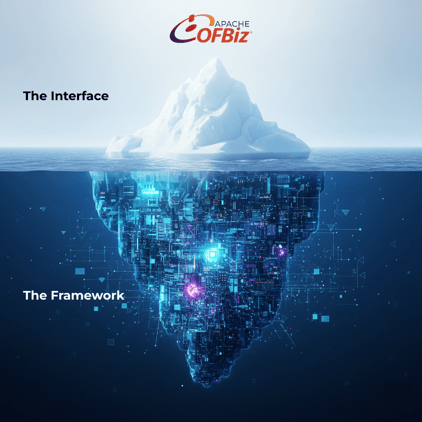
Apache OFBiz was never designed as a packaged, industry-specific SaaS ERP.
It is an enterprise software application development framework with pre-built business applications.
The UI that ships with Apache OFBiz was first built more than two decades ago. It was not intended for end-users, and the screens are meant to help developers de-bug and test applications as they are being built. For that use, by the way, they work great. Over time, the community has concentrated its efforts primarily on strengthening:
As a result, the core architecture has continued to mature and evolve, even though the reference UI has not undergone a major redesign. This does not mean user experience is unimportant.
Instead, the handling of UI reflects flexibility.
For some organizations, the out-of-the-box interface is sufficient. They prioritize leveraging the existing business logic quickly without investing additional effort into redesigning workflows, and they are not planning to put these screens in front of non-developer end-users. For these teams, backend capability and implementation speed are the priority.
For others, especially enterprises with complex workflows or strong UX expectations, the strategy is different. They choose to build a modern user experience tailored to their industry, while using Apache OFBiz as the backend engine. This is a highly effective approach, allowing builders to leverage the UX technology of their choice, taking complete control of end-user UX.
Both approaches are valid. Both are used today.
Apache OFBiz does not force a single UX philosophy. It leaves that decision to the organization.
It is equally important to clarify what Apache OFBiz delivers. It is not just an enterprise application development framework like Spring, where every application must be built from scratch.
It includes extensive business logic across domains such as:
These capabilities are already implemented and refined.
Organizations do not need to reinvent core business logics. They inherit a mature engine and decide how to present it.
That distinction matters.
Enterprises typically choose one of two approaches.
Organizations with strong frontend teams build modern interfaces using frameworks such as Vue.js or React. Apache OFBiz operates headlessly through REST APIs, serving as the ERP engine while the frontend delivers a polished, industry-specific experience.
Others adopt an accelerator platform built on top of Apache OFBiz.
For example, the HotWax Accelerator is built using the Apache OFBiz backend and business logic, but the UI and UX have been fully redesigned. It abstracts Party and Role complexity while preserving the same structural foundation.
The Accelerator is not limited to a specific industry, but it significantly improves usability compared to the OOTB OFBiz reference UI and accelerates time-to-value.
Organizations may either:
In both cases, the underlying engine remains the same.
This is not theoretical.
Modern enterprise teams are already building intuitive, workflow-driven experiences on top of Apache OFBiz-based architectures.
Examples include:
Order Fulfillment
Demo: Fulfilling orders from stores
Order Routing Configuration
Demo: How an Order Routing Engine works?
Receiving Inventory at Stores
Demo: How do you make receiving inventory at your stores a lot easier?
These examples demonstrate that the backend framework does not constrain the user experience. When paired with a modern frontend strategy, Apache OFBiz becomes workflow-oriented, role-abstracted, and enterprise-polished.
Organizations that want to see tailored workflows in action can engage implementation partners to design UX layers specific to their operational model, whether through an accelerator approach or fully custom frontend development.
The evolution continues.
The Apache OFBiz community has introduced an MCP (Model Context Protocol) server, enabling structured integration with modern LLM ecosystems.
Because Apache OFBiz has:
It integrates naturally into AI-driven workflows and orchestration systems.
In an era where many ERP platforms are retrofitting AI onto rigid architectures, Apache OFBiz’s framework-first design positions it well for building intelligent agentic commerce applications powered by LLM models.
Apache OFBiz ships with a developer-focused reference UI, but by the strength of its engine is the real underlying value.
Thus, it can be evaluated by:
It becomes clear that it is not a legacy ERP product. It is a modern, extensible enterprise platform. The architecture reflects decades of enterprise refinement. Some developers choose to use the reference UI and move quickly. Others build modern UX layers that transform how end-users interact with the system. The foundation supports both. In enterprise systems, architecture is the long-term asset. Front end technologies change quickly, and UX can always be redesigned. The engine is what endures.
At HotWax Systems, our team of Apache OFBiz experts brings years of hands-on experience turning this powerful engine into tailored solutions for businesses worldwide. Whether you are looking to modernize your operations or build from the ground up, connect with our experts at HotWax Systems and get your custom solution built on the HotWax Accelerator.