Inventory can be high while service levels remain low. Materials arrive ahead of need, finished goods sit in the wrong location, and an order misses its delivery window despite stock elsewhere in the network. Each function may be meeting its targets while the business carries more inventory and still disappoints customers.
Supply chain optimization means improving that balance: having the right product, in the right quantity, at the right time, and delivering it to the customer when promised. Excess stock ties up working capital. Too little stock costs sales or interrupts production. Stock that cannot be located, allocated or shipped in time offers limited protection against either problem.
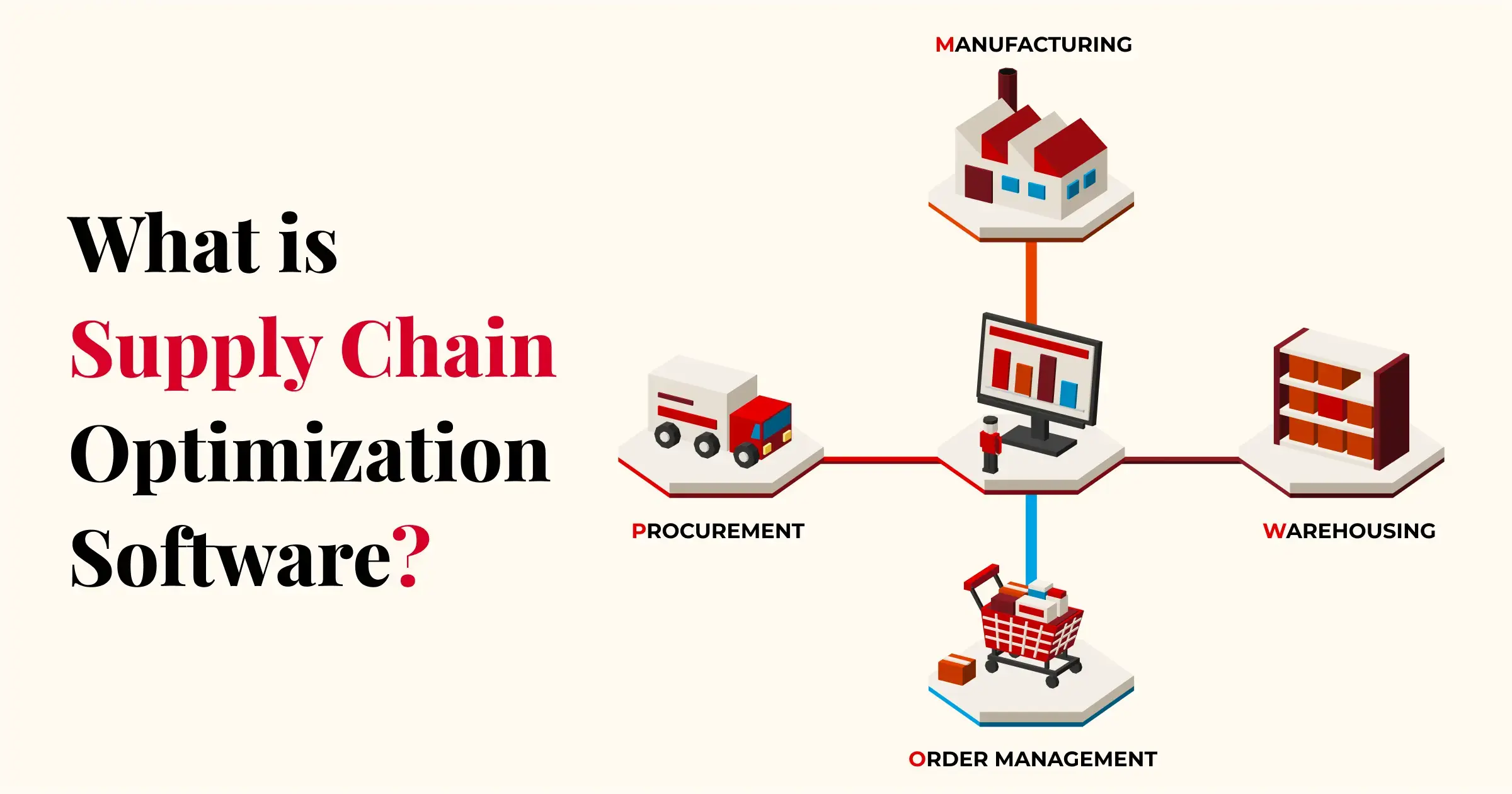
For supply chain leaders evaluating supply chain optimization software, four core applications help turn this objective into daily execution: a procurement management system, a manufacturing execution and planning system, a warehouse management system and an order management system. Their individual capabilities matter. So does their ability to coordinate decisions around inventory.
What supply chain optimization software needs to connect
Supply chain optimization spans service, cost, capacity and inventory. Forecasting, network design and advanced planning have important roles, but operational applications determine whether plans survive contact with supplier delays, production exceptions and changing customer demand.
Procurement controls incoming supply and purchasing commitments. Manufacturing execution connects material consumption to production output. WMS maintains control of physical stock and warehouse execution. OMS connects available supply to customer orders and fulfillment promises.
These applications support decisions through visibility, workflows and configured rules. Supply chain teams still set priorities, approve commitments and manage exceptions. The objective is to make those decisions consistent across functions, with fewer gaps between what one team knows and another team acts on.
Procurement management system: protect availability and cash
A purchasing decision affects more than unit cost. A larger order may secure a discount while increasing holding costs; a cheaper supplier may introduce lead-time variability that requires more safety stock.
A procurement management system helps teams evaluate these trade-offs using demand, current stock, outstanding supply, supplier lead times and order constraints. Replenishment recommendations need to reflect what is already committed or on order, alongside the business’s service and inventory policies.
The operational connection is equally important. Purchase approvals, expected receipts, accepted quantities and supplier invoices should form a traceable sequence. If part of a delivery is rejected, planning needs the usable quantity and finance needs the receipt evidence. Otherwise, the business can pay for supply that is not available to meet demand.
The contribution to supply chain optimization is disciplined replenishment: securing the required supply without allowing purchasing targets to create unnecessary inventory downstream.
Manufacturing execution and planning system: make availability credible
For manufacturers, inventory availability depends on what the operation can actually produce, not just what is scheduled. A missing component, yield loss or delayed production run can change both material requirements and customer commitments.
Manufacturing execution systems provide the operational feedback: work in progress, material consumption, production status and completed output. Planning capabilities such as MRP and scheduling address the related questions of what to buy or make, and when. A manufacturing execution and planning system brings these capabilities together.
Their value lies in closing the loop. When output falls short, procurement needs revised material requirements and order management needs a revised view of supply. When production finishes early, that stock should become eligible for fulfillment after the relevant receipt and quality steps.
This helps prevent two expensive reactions: buying materials that are no longer needed and promising finished goods that will not be ready. Distributors may not need manufacturing execution; manufacturers need its feedback to keep the rest of the chain aligned.
Warehouse management system: turn stock into reliable execution
An inventory record is only useful if warehouse teams can find the correct product, in the required condition, and dispatch it before the cutoff. Receiving accuracy, location control and timely movement transactions are therefore service-level concerns as much as warehouse concerns.
Warehouse managers establish storage policies and execution priorities. A warehouse management system (WMS) supports those policies through receiving, putaway, replenishment, cycle counting and pick-pack-ship workflows. Lot and serial tracking help teams select eligible stock; configured pick waves organize work around priorities and available capacity.
The connection to other functions is direct. Receiving updates incoming supply. Quality holds constrain usable stock. Confirmed shipments update physical inventory. A warehouse exception must reach order management early enough to support reallocation or a revised customer commitment.
For supply chain optimization, warehouse performance is more than picking speed. It is the ability to convert available stock into accurate, timely shipments while maintaining trustworthy inventory records.
Order management system: support same-day and next-day delivery
Customers experience the delivery promise, not the inventory balance. A network may have enough stock overall yet fail a next-day order because it allocates from a location that cannot dispatch in time.
An order management system (OMS) connects demand to fulfillment options across warehouses, stores and other eligible locations. Allocation rules can consider availability, location, shipping cost and service priorities. A credible same-day or next-day proposition also requires warehouse capacity, order cutoffs, carrier services and transit times to be reflected in the fulfillment process.
The nearest location is not always the best choice. A nearby store may have stock but insufficient fulfillment capacity; a more distant warehouse may still meet the promise through an appropriate carrier service. Splitting an order may improve delivery speed while increasing cost. These are policy decisions that an OMS helps the business execute consistently.
An OMS also coordinates reservations, partial shipments, backorders, cancellations and returns. Reserving stock reduces what can be promised to other orders; shipping reduces physical on-hand. Keeping those states aligned helps prevent overselling without unnecessarily withholding stock from sale.
OMS is therefore central to delivery performance, but it cannot guarantee speed alone. Its decisions depend on accurate inventory and dependable execution by warehouses, stores and carriers.
Inventory connects procure-to-pay and order-to-cash
The four applications meet across two business processes. Procure-to-pay links an approved need to purchasing, receipt, invoice matching and supplier payment. Order-to-cash links a customer order to allocation, fulfillment, invoicing and payment collection. Finance completes the accounting and settlement steps through the relevant application or integration.
Consider a manufacturer fulfilling an order for 100 units. It has 40 uncommitted, saleable units and a confirmed production run for another 60 before the dispatch deadline. Those 60 units are expected supply, not stock ready to pick.
Procurement verifies material availability and addresses any shortfall. Manufacturing reports actual progress and output. WMS receives and locates eligible finished goods, then executes fulfillment. OMS manages the customer commitment against confirmed supply and the dispatch window. If production delivers only 50 units, the shortage should trigger an exception before the warehouse discovers it during picking.
Whether to split the shipment, source the remaining quantity elsewhere or revise the promise depends on customer agreements and business priorities. A connected process makes the exception visible to the teams responsible for acting on it.
This requires a shared understanding of inventory, rather than a single undifferentiated number. On-hand, reserved, available, inbound, and work-in-progress quantities answer different questions. Product, location, and inventory-status definitions must remain consistent as transactions move between applications.
Choosing supply chain optimization software across buying cycles
Organizations rarely replace their entire supply chain application landscape at once. A WMS may be introduced to address warehouse complexity, an OMS added as fulfillment channels expand, and procurement or manufacturing capabilities modernized later. Some organizations buy two or more within a suite; others combine specialist applications with an existing ERP.
Both approaches can work. Separate systems need reliable interfaces, clear ownership of updates and reconciliation. A common platform can reduce the number of internal interfaces, but still requires accurate master data, timely transactions, and integration with retained systems.
When evaluating supply chain optimization software, the practical question is whether a change in supply, demand or inventory reaches the next decision in time. Evaluate that through exceptions like short receipts, production delays, order cancellations, and missed cutoffs, not only through a normal-flow demonstration.
Apache OFBiz as a foundation for supply chain optimization software
Apache OFBiz is an open-source business application platform with procurement, manufacturing, warehouse and inventory, and order management capabilities. Its shared business model provides a foundation for managing these processes together.
An organization can implement the capabilities it needs: one application, a combination, or all four. It can also start with one and extend the scope over time. A warehouse-led rollout, for example, can retain an existing OMS initially and add procurement or manufacturing capabilities as priorities change.
This is phased implementation, with configuration, data preparation, and integration work still required. The advantage is that subsequent capabilities can build on the same product, order and inventory foundation rather than introducing another independent model for each function.
HotWax Accelerator: connected applications with inventory at the center
HotWax Systems builds on Apache OFBiz through HotWax Accelerator, bringing together Procurement Management System, Manufacturing Execution & Planning System, WMS and OMS as specialized applications or a unified enterprise solution. It adds a modern user experience designed around business roles, along with search, integration, and analytics capabilities.
The application workflows make that foundation operational:
Procurement connects supplier evaluation and replenishment with purchase approvals, receiving and vendor invoicing.
Manufacturing Execution & Planning connects bills of materials, routings, requirements planning and production runs.
WMS supports inventory control and movement alongside configurable pick waves, barcode-driven picking, packing and carrier integration.
OMS combines inventory visibility across locations with order allocation, distributed fulfillment, store fulfillment and returns.
When implemented together, these applications use the shared Apache OFBiz foundation to coordinate supply commitments, production, warehouse movements and customer orders. Inventory is central to that relationship: each team works with the relevant state of the same business stock, rather than treating its own inventory view as an isolated record.
For users, role-focused workflows put the relevant tasks and exceptions within reach. For leadership, the opportunity is to improve an end-to-end process while retaining the flexibility to configure or extend the applications around operational requirements.
Apache OFBiz is open source. HotWax Accelerator is source-available to HotWax Systems clients through implementation engagements, with access to customize its code. The starting point is an existing application foundation that is configured and extended for the organization.
Choose the starting point by business impact
Begin where the gap between inventory investment and customer service is most costly. Unreliable replenishment may point to procurement; uncertain production availability to manufacturing; execution errors to WMS; and inconsistent delivery promises across locations to OMS.
Measure progress across the process. Pair inventory days and working capital with fill rate, delivery performance and fulfillment cost. A reduction in stock that damages service, or faster delivery achieved through unsustainable expediting does not resolve the underlying trade-off.
Supply chain optimization software delivers value when purchasing, production, warehouse execution and order fulfillment support the same promise: the right product, in the right quantity, delivered at the right time.
Connect with HotWax Systems to map your procure-to-pay and order-to-cash gaps, identify the application to implement first, and plan how the remaining capabilities can join a common inventory foundation.