
MACH architecture arrived through eCommerce. The vendors who popularized the term sell content platforms and storefronts, and most of the material explaining it assumes you are rebuilding a website. Manufacturers and distributors now hear the same term applied to warehouse, order, and production systems, where the stakes and the constraints are different.
The translation matters. A storefront that loses its recommendation service for ten minutes shows a slightly worse page. A warehouse that loses its inventory service for ten minutes stops shipping. Architectural advice built for one of those situations does not transfer cleanly to the other.
This blog defines the four principles behind MACH architecture, translates each one into what it means for supply chain operations, shows where Apache OFBiz and Moqui actually sit against those principles, and describes one concrete shape a MACH architecture takes in a working supply chain operation.
What Is MACH Architecture?
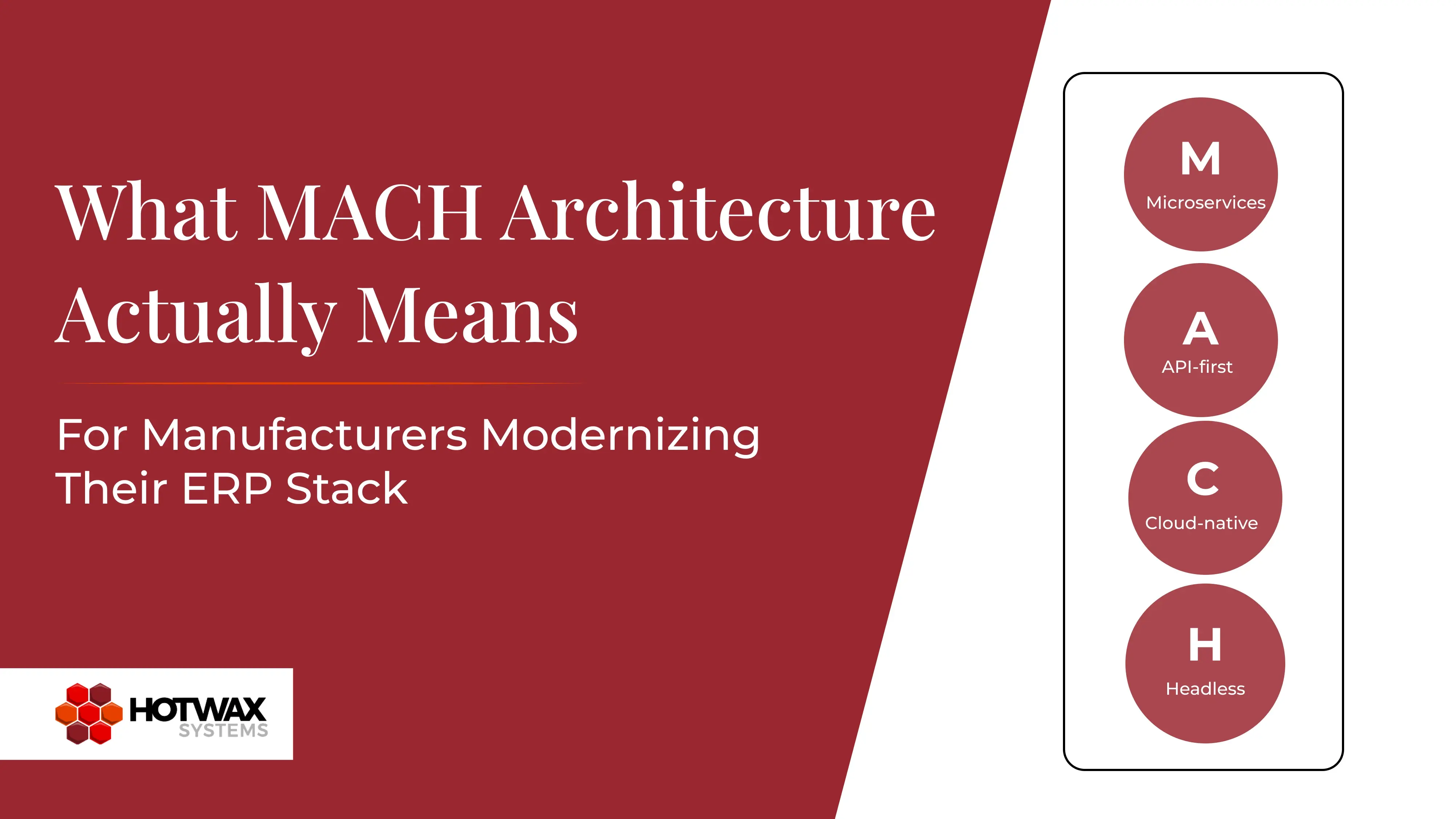
MACH architecture is an acronym covering four design principles that are usually adopted together: Microservices, API-first, Cloud-native and Headless.
Microservices: Business capabilities are built as separate services, each with its own codebase and deployment cycle, organized around a single responsibility and loosely coupled to the others. Rather than one application handling inventory, orders, and procurement, each becomes a service that a team can change and release on its own.
API-first: Every piece of business functionality is exposed through a defined contract before any user interface is built. The API is the product, and interfaces are consumers of it.
Cloud-native: The system is designed to run on cloud infrastructure, with the deployment and release practices that come with it, including continuous integration and automated delivery.
Headless: The user experience is decoupled from the backend entirely. Business logic is reached through APIs, and any number of interfaces can sit on top of it.
The four principles of MACH architecture reinforce each other. Microservices need APIs to communicate, APIs make headless interfaces possible, and cloud infrastructure is what makes running many independent services practical. The intended payoff is that any single component can be replaced without rebuilding the rest.
Worth noting: MACH architecture describes principles, not a certification. No standards body audits compliance, and vendors apply the label with varying strictness. A system can satisfy three of the four and still deliver most of the practical benefit, which turns out to matter a great deal for supply chain software, where the four principles carry very different weights.
Why MACH Architecture Entered the ERP Conversation
Traditional enterprise resource planning (ERP) systems were built as single large applications. Finance, inventory, procurement, and production shared one codebase, one database, and one release cycle. That design was reasonable when business processes changed every few years.
Supply chains no longer work that way. Sourcing moves between regions, sales channels get added, fulfillment models change, and compliance requirements shift. Each of those changes means a modification to the operational system, and in a monolithic ERP every modification competes for the same release cycle and carries risk to everything else running on that codebase.
This is the pressure MACH architecture responds to. When the parts of your operation that change most often are separated from the parts that rarely change, you can move quickly where speed matters without destabilizing the rest. A company adjusting its order routing logic every quarter has a real reason to want that logic isolated from its general ledger.
What the Four Principles Mean on a Warehouse Floor
The principles behind MACH architecture are easier to judge against concrete operations than in the abstract, so the four below are set against a working warehouse.
Microservices in practice. Consider a warehouse operation running receiving, putaway, picking, packing, and shipping. Picking logic changes constantly, since it depends on layout, seasonal volume, and labor availability. Receiving logic barely changes at all. Separating them means a change to pick wave grouping is tested and released without touching the receiving flow that regulatory audits depend on. The cost is that inventory state now has to stay consistent across service boundaries, and inventory accuracy is the one thing a warehouse cannot get wrong.
API-first in practice. A defined API contract over order and inventory data is what lets a scanner application, a customer portal, a carrier integration, and a supplier feed all read the same numbers. Without it, each integration becomes a direct database connection or a scheduled file transfer, and those are the integrations that break silently when the schema changes.
Cloud-native in practice. For warehouse operations this means capacity that flexes with seasonal volume and a release process that does not require scheduled downtime. It also introduces the constraint covered in our blog on cloud-based warehouse management software, since equipment such as conveyors and sortation systems expects response times that a remote data center does not always deliver.
Headless in practice. Decoupling the interface is what allows a picker on a handheld scanner, a supervisor on a dashboard, and a customer checking order status to run against the same business logic through different interfaces. For operations whose staff work on the floor rather than at desks, this is often the principle with the most immediate payoff.
Where Apache OFBiz and Moqui Sit Against MACH Architecture
Claiming any established ERP platform is fully MACH compliant would overstate things, so it is worth being precise about what these platforms actually provide.
Apache OFBiz has a component-based architecture organized as a modular monolith. Its applications for order management, warehouse management, manufacturing, and procurement are separate components sharing one underlying data model and one deployment. On the microservices principle of MACH architecture, it does not qualify, and describing it otherwise would be inaccurate.
On the other three principles the picture is different. Apache OFBiz includes built-in support for REST APIs, JSON messaging, and asynchronous service calls, which covers the API-first principle in substance. It deploys to cloud infrastructure without modification. It runs headlessly, acting as the backend engine while interfaces are built separately in front-end frameworks such as Vue.js or React, an approach covered in more depth in our blog on Apache OFBiz behind a modern interface.
Moqui Framework takes the closer position on the one principle of MACH architecture that Apache OFBiz does not meet. Built on a decade of experience with Apache OFBiz patterns, it uses a service-oriented three-tier design suited to microservices deployment.
The honest summary is that a supply chain platform built on Apache OFBiz gives you three of the four principles as standard, with a shared data model in place of service separation. For many operations that trade is the right one. Inventory consistency across receiving, production, and fulfillment is simpler to guarantee inside one data model than across service boundaries, and inventory consistency is usually the requirement that outranks deployment independence.
Where the Apache OFBiz Project Is Heading
The distance between Apache OFBiz and full MACH architecture is not fixed, and the direction of travel is public. The project's development mailing list carries several active proposals that map onto the principles covered in this blog.
In October 2025, a proposal was raised to move the bundled applications out of the Apache OFBiz framework and manage them the way plugins are handled today. The aim stated in the proposal is a lighter foundation that developers can build on without pulling in every default application and its accompanying data model, described as a base for domain-specific or microservice-based solutions. That addresses the microservices principle where it actually bites, which is packaging and deployment granularity rather than vocabulary.
Work that began as a March 2026 proposal for a headless, API-first manufacturing application is now building. Manufacturing services are exposed as REST APIs, and progressive web applications consuming them have been shared with the community, including a production run application. Contributors from HotWax Systems have been part of that work.
The REST API component has moved out of the plugins repository into the framework itself, with commit history preserved, making API access part of the core platform rather than an optional addition. A related suggestion in that thread would let plugins declare REST endpoints through configuration files, exposing existing services without changes to core code.
Taken together they show a platform that has moved from discussing these principles to shipping against them, while keeping the shared data model that supply chain operations depend on.
One Shape a MACH Supply Chain Stack Takes
Principles are easier to judge against a concrete arrangement, so the rest of this blog describes one shape that appears repeatedly in supply chain deployments built along these lines.
At the centre sits a single system of record holding the data model and the business rules: inventory, orders, bills of material, facilities, and the logic that governs how each of them changes. Apache OFBiz occupies this position in the deployments described earlier in this blog. Every capability it holds is reachable through REST contracts, and nothing above it talks to the database directly.
Above that sit several small applications rather than one interface. Each is built for a single role and a single situation: a receiving application for the dock, a picking application for a handheld scanner, a supervisor dashboard, a customer-facing order status page. Each communicates only through the API layer. None of them holds business logic of its own.
Beside them sit partner adapters, one per external relationship, translating a carrier API, a third-party logistics feed, or a retail customer's document format into the same contracts the applications use.
The manufacturing work on the Apache OFBiz development mailing list follows exactly this arrangement. Services are exposed as REST APIs, and a progressive web application consumes them. The shape is not theoretical. The services and the first applications already exist, and the work is visible in the open.
What Stays Together and What Comes Apart
The arrangement above separates aggressively in one dimension and refuses to separate in another, which is the part worth understanding.
What comes apart: the interfaces. A warehouse does not have one kind of user. A picker holding a scanner in a cold aisle needs four fields, large touch targets, and barcode input. A supervisor needs aggregate views across zones and shifts. Building one application that serves both produces something neither uses comfortably. Separate applications against a shared API let each match its actual job, and a new role becomes a new application rather than another tab in an overloaded screen.
What comes apart: the partner connections. Each adapter is independently replaceable. Onboarding a carrier, or dropping one, touches a single component, and a partner changing their file format never reaches the applications.
What stays together: the data model and the rules that govern it. Receiving, production, picking, and shipping write to the same records inside one system. This is the deliberate choice, and the reason is that an inventory rule has to hold identically no matter what triggered it. A unit received through the dock application, through a nightly supplier file, and through a manual correction by a supervisor must be subject to the same validation, and the simplest way to guarantee that is one implementation of the rule with everything calling it.
Underneath this sits one rule about direction: the arrangement separates by consumer rather than by capability. Splitting by consumer, meaning one application per role and one adapter per partner, delivers the flexibility organizations actually want from MACH architecture. Splitting by capability, meaning inventory as one service and orders as another, is where the cost rises sharply, since capabilities in a supply chain share state constantly while consumers do not.
How One Backend Serves Very Different Consumers
Those four consumers want incompatible things from the same data, which is the clearest argument for headless in an operational setting.
A scanner application needs low latency and tolerance for a weak signal in a metal building. It reads a handful of fields and writes small, frequent updates.
Supervisor dashboards need the opposite: aggregated reads across thousands of records, refreshed periodically, with no write path at all.
Partner adapters work in batches on someone else's schedule, processing a file of several thousand lines in one window, with retry behaviour and error reporting the interactive applications never need.
Customer status pages serve high read volume from outside the network, where the security posture and caching strategy differ from anything running inside the warehouse.
One application serving all four would have to compromise on each. Separate consumers against one API layer let each make its own choices about caching, offline behaviour, and refresh rate, while the rules they exercise stay in one place. Apache OFBiz supports the batch case through its service engine, where an adapter runs asynchronously against a schedule and still passes through the same validation an interactive request would, a model covered in our engineering blog on asynchronous services in Apache OFBiz.
An operation arriving at this shape has adopted three of the four principles of MACH architecture in full. API-first governs every interaction, headless is the reason four consumers coexist, and cloud deployment carries the whole arrangement. Microservices remain partial by choice, since the system of record stays one deployment against one data model. For most supply chain operations that is the configuration worth building toward, and it can be reached from a system already running rather than through replacement.
The shape in summary:
- One system of record holding the data model and the rules that change it
- Every capability reachable through defined API contracts
- One application per role, not one interface for everyone
- One adapter per external partner
- Separation applied where consumers differ, not where capabilities do
If you are working out what this shape would look like for your own facilities, talk to HotWax Systems about which consumers your operation actually has and what sits between them and your system of record.