/What%20is%20the%20MRP%20Process-%20Blog%20image.webp)
/Role%20of%20BOM%20in%20MRP%20Blog%20Image%201.webp)
How Does the Manufacturing Bill of Materials Work in the MRP Process?


Ask any production planner what keeps them up at night, and the answer is usually a version of the same worry: will the right materials be there when the line needs them? Manufacturers, large and small, live with that tension every day. Demand shifts, suppliers slip, and a single missing component can stall an entire build. Keeping materials, timing, and demand in balance is the core problem that manufacturing planning has to solve.
For a long time, planners leaned on spreadsheets and experience to manage it. That holds up in a small shop with steady demand, but it falls apart once you add multiple components, long lead times, and orders that change week to week. At that scale, manual tracking cannot keep pace, and the errors start to cost real money. That is where MRP comes in.
MRP comes in two forms: Material Requirements Planning (MRP I), which works out material needs from demand, and Manufacturing Resource Planning (MRP II), which widens the scope to resources such as labor and equipment. This blog stays with MRP I: what the MRP process is, the objectives it serves, the inputs it depends on, a worked example, and how a platform such as Apache OFBiz automates it.
The MRP process is a structured, time-phased approach manufacturers use to make sure materials, whether purchased or produced, are available when needed to fulfill production and delivery commitments. It converts demand signals, such as sales orders or forecasts, into detailed plans for procuring and producing materials across every level of the production hierarchy.
The process starts by checking demand in the system, driven by new sales orders and forecasts, and then evaluating the current inventory of finished goods. It refers to the bill of materials (BOM), which breaks each finished product down into its components and sub-components. For every required item, the system determines whether it should be purchased externally or produced in-house.
One of the most powerful aspects of MRP is its ability to compute the required-by dates for every item in the production chain. Starting from the estimated delivery date of a sales order, MRP works backward to determine when each component or sub-component must be available to avoid bottlenecks or production delays. This accounts for procurement lead times, production times, and inventory availability at each stage. The result is a clear, calendar-based view of material needs that lets planners schedule work precisely and meet delivery expectations without overstocking.
MRP is designed to match supply with demand while optimizing resources for smooth, efficient production. Its main objectives include:
Make sure materials are available. MRP helps guarantee that all required materials and components are on hand when production needs them. This prevents shop-floor interruptions caused by missing parts and lets manufacturing proceed without delays.
Maintain minimum inventory levels. By calculating exact quantities, MRP keeps stock at an optimum level, freeing up working capital and cutting storage costs.
Optimize production schedules. MRP aligns material availability with production plans and determines the date each component must be ready, supporting full use of capacity and timely order fulfillment.
Improve overall efficiency. By factoring in demand, forecasts, inventory data, and production needs, MRP supports better decisions across procurement and manufacturing, which reduces waste and smooths operations.
The MRP process relies on three critical inputs to plan material requirements accurately and schedule production efficiently. These inputs define what materials are needed, in what quantities, and when.
Master production schedule (MPS). The master production schedule defines the quantities of finished products to produce within specific time frames. It reflects customer orders, forecasts, and inventory targets, and it gives MRP the timeline and volume that guide procurement and production.
Bill of materials (BOM). The bill of materials lists all raw materials, components, and sub-assemblies required to produce a finished product, along with quantities and the relationship between assemblies and their parts. MRP uses the BOM to break finished product demand into specific material requirements.
Inventory snapshot. The inventory snapshot provides real-time data on current stock levels of raw materials, components, and finished goods, including quantities on hand, allocated, and on order. This helps avoid both shortages and excess inventory.
Together, these inputs let MRP create an accurate, actionable plan that balances production demand against available supply. The example below shows how they work together for a skateboard built on a multi-level BOM with varying inventory levels, quantity ratios, and lead times.
To show how MRP software handles material requirements planning, here is a real-world scenario from a company that produces skateboards. The example includes a multi-level BOM with both purchased and in-house manufactured components, along with a defined production schedule.
In this scenario, a sales order is received on June 10 for 100 skateboards, with a delivery date of June 22.
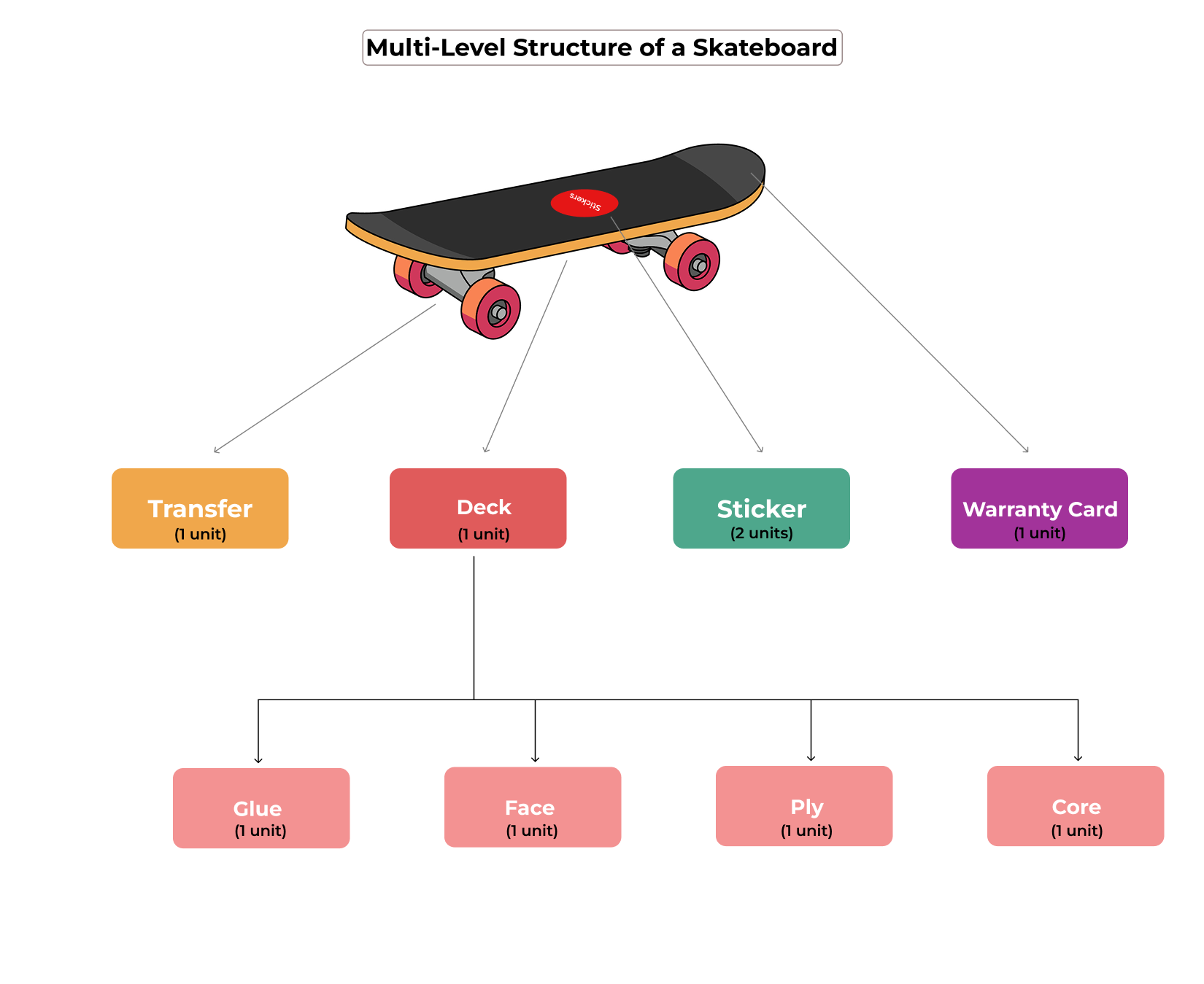
| Item | Quantity on Hand |
|---|---|
| Stickers | 120 |
| Transfer | 80 |
| Warranty Card | 100 |
| Deck | 20 |
| Glue | 40 |
| Ply | 30 |
| Core | 40 |
| Face | 20 |
| BOM Level | Item | Gross Req. | Qty On Hand | Net Req. | Action |
|---|---|---|---|---|---|
| 0 | Skateboard | 100 | 0 | 100 | Produce |
| 1 | Stickers | 200 | 120 | 80 | Purchase |
| 1 | Transfers | 100 | 80 | 20 | Purchase |
| 1 | Warranty Cards | 100 | 100 | 0 | No action |
| 1 | Decks | 100 | 20 | 80 | Assemble in-house |
| 2 | Glue | 100 | 40 | 60 | Purchase |
| 2 | Ply | 100 | 30 | 70 | Purchase |
| 2 | Core | 100 | 40 | 60 | Purchase |
| 2 | Face | 100 | 20 | 80 | Purchase |
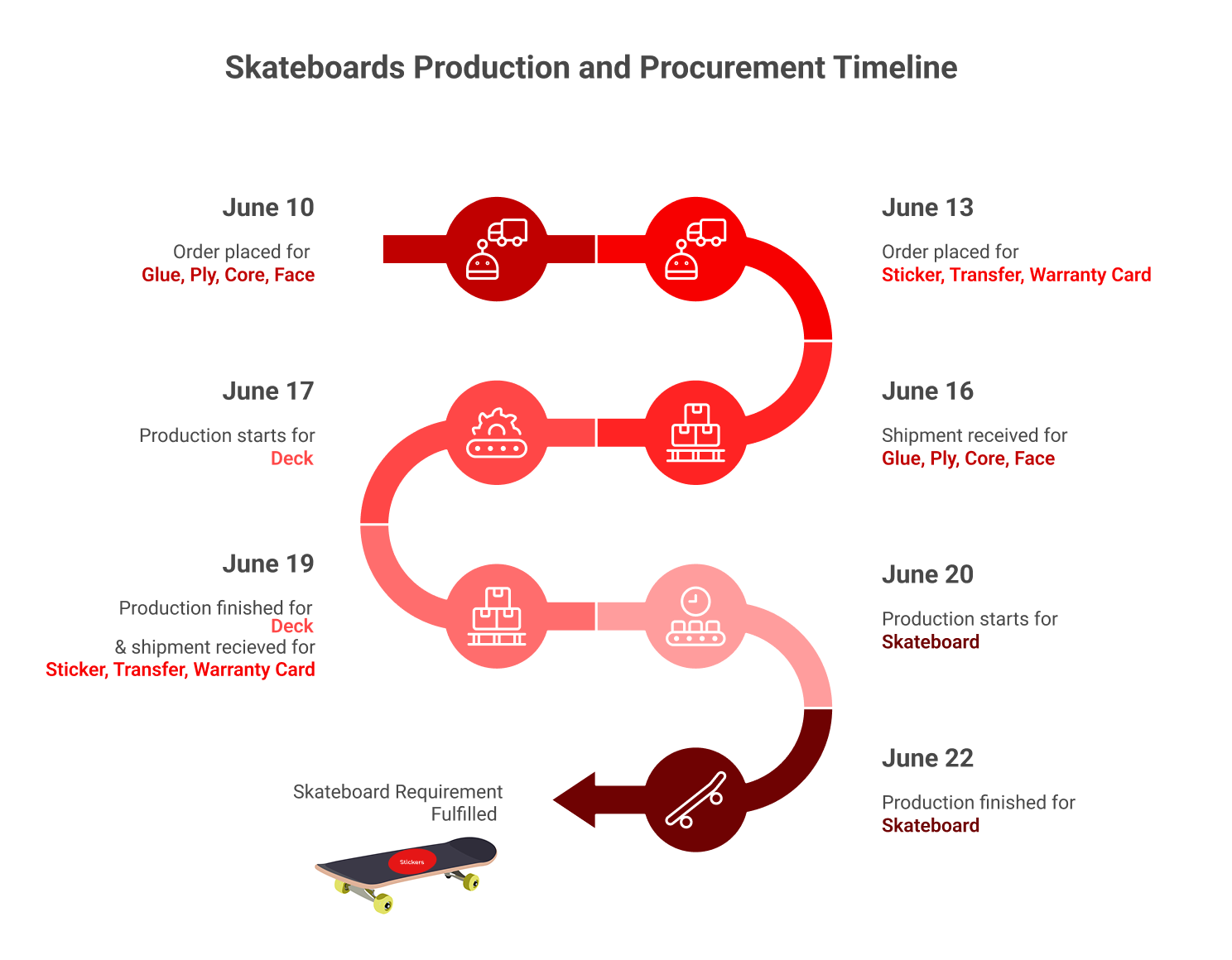
| Item | Action | Quantity | Required-by | Start Date |
|---|---|---|---|---|
| Stickers | Purchase | 80 | June 19 | June 13 |
| Transfers | Purchase | 20 | June 19 | June 13 |
| Warranty Cards | No action needed | 0 | - | - |
| Decks | Assemble in-house | 80 | June 19 | June 17 |
| Glue | Purchase | 60 | June 16 | June 10 |
| Ply | Purchase | 70 | June 16 | June 10 |
| Core | Purchase | 60 | June 16 | June 10 |
| Face | Purchase | 80 | June 16 | June 10 |
This example shows how MRP works across different levels of a BOM: breaking finished product demand into component requirements, checking inventory, and calculating exact quantities with required-by dates. It makes sure every material, whether purchased or produced, is available when needed so production runs on time.
MRP is a powerful planning tool, but it relies on accurate inputs and timely updates. Even a well-structured system can hit roadblocks if these challenges are not addressed:
Maintaining accuracy in BOM setup. An incomplete or outdated bill of materials leads to material shortages or procurement of the wrong parts. MRP needs accurate multi-level BOMs to calculate component needs correctly.
Keeping data accurate and current. MRP calculations are only as good as the data behind them. If inventory records, BOMs, or forecasts are not updated, the plan can drive overproduction, stockouts, or unnecessary procurement.
Dealing with changing lead times. MRP assumes fixed lead times. Supplier delays, transportation issues, or shop-floor bottlenecks can disrupt the actual timelines and cause missed delivery dates.
Aligning material planning with production capacity. Traditional MRP does not always account for real machine or labor capacity, so material availability may not match actual production capability.
Overcoming these challenges takes more than awareness. It takes the right tools. A capable MRP software determines accurate material requirements, avoiding both understocking and overstocking while keeping production on track.
Done well, MRP turns a moving target into a clear plan. It takes demand from sales orders, forecasts, and inventory targets and converts it into exact material and component requirements, each with a date attached, so nothing needed for production goes missing and nothing sits in excess. That is what makes it the backbone of demand-driven manufacturing.
In practice, MRP runs inside a Manufacturing Execution and Planning Solution (MEPS). One such option sits on the Apache OFBiz platform, developed under the Apache Software Foundation. Apache OFBiz is a unified enterprise solution built around supply chain management, and its manufacturing module runs an intelligent MRP I engine that delivers full material requirements planning on an open source stack.
If you want to build a custom Manufacturing Execution and Planning Solution with a capable MRP engine on Apache OFBiz, talk to our team of experts at HotWax Systems to put open source Apache OFBiz to work for your operation.



/Frame%20984.webp)
/Custom%20Manufacturing%20Software%20Development-1.webp)